
I attended Geotab Connect in Las Vegas as part of AfMA’s study tour, travelling with a delegation who also took part in operational site visits later in the week. With more than 4,000 delegates, the event brought together many of the people shaping how data and analytics is being used across fleet and infrastructure. I went expecting to hear a lot about telematics, IoT, and AI. That expectation was met, but it was not what stayed with me.
What lingered instead was a quieter, more consequential idea. We are no longer constrained by what we can measure. The real constraint is whether we are willing to imagine how information can be brought together and used.
Geotab’s long-standing motto, “you can’t manage what you can measure”, has guided fleet thinking for years. Historically, that measurement was almost entirely vehicle centric. Location, kilometres, fuel use, harsh events, idle time. The correlations were clear, the feedback loops were short, and fleet managers could see, often very directly, how data informed decisions.
What became clear across the opening keynote, the closing keynote, and several panel discussions is that measurement itself is no longer the limiting factor. The volume and variety of relevant data that can now be drawn into shared analytical environments is almost inconceivable compared to where fleet began. Vehicle data is still important, but it is now only one layer.
Weather, ambient temperature, road conditions, enterprise systems, financial systems, historical trends, seasonal patterns, operational schedules, and task-specific context can all be pulled together through APIs and shared platforms. Artificial intelligence does not replace judgement in this environment, but it does make this level of complexity usable. It allows comparisons, patterns, and exceptions to be surfaced at a scale that would otherwise be impossible.
What struck me most is that there remains a degree of blindness to what this makes possible. Not because organisations lack tools, but because many of us are still framing telematics as a fleet system, rather than as an input into broader operational understanding.
One panel discussion, focused on public works, illustrated this perfectly through a winter operations example involving salt broadcasting. By combining vehicle movement data with weather conditions, road temperature, historical treatment effectiveness, and timing, organisations were able to materially improve how, when, and where salt was applied. The outcome was not just operational efficiency, but reduced waste, improved safety outcomes, and better accountability.
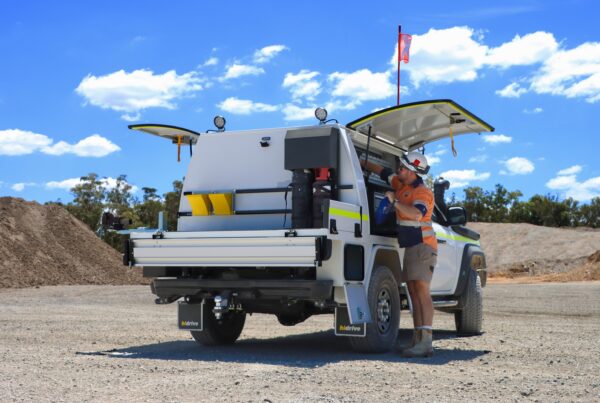
That example is not directly transferable to Australia, but it prompted an important line of thinking. In Australian road maintenance, construction, and mining operations, we broadcast water to manage dust, road condition, and tyre wear. Water is an extremely valuable and constrained resource, yet in many contexts we have limited visibility of how much is used, where, under what conditions, and with what effect.
The question is not whether the same solution applies. The question is one of imagination. If drawing a small number of contextual data points together can materially improve outcomes in one environment, what other operational activities are effectively invisible simply because we have never connected the dots?
Another conversation that stayed with me emerged later, when AfMA’s study group were discussing key takeaways from the event. Engine idle time and exception reporting came up, an area long treated as a blunt metric and often framed as inefficiency or non-compliance.
But when weather data, ambient temperature, and task context are considered, a different picture emerges. Many vehicles function as mobile offices, rest spaces, or heating and cooling stations for workers in the field. In those circumstances, idle time is not a failure, it is a signal.
Pulling in relatively simple IoT data can turn a compliance conversation into an informed discussion about working conditions, task design, vehicle specification, and resourcing. It can help identify trends, constraints, and opportunities that fleet managers have understood intuitively for years but struggled to evidence without context.
Throughout all of this, one constant remains. Safety has always been, and must remain, the primary driver. Fleet activities touch almost every part of an organisation, and they do so in dynamic, public, and often high-risk environments. That exposure makes fleet one of the most significant organisational risk profiles, often without being fully recognised.
Safety remains a critical consideration in fleet and operational decision-making. What is changing is our ability to better understand worker health, long before it manifests as a safety issue. One session, delivered by a clinician, offered a subtle but thought-provoking reminder. In work health and safety, health comes before safety for a reason. Mental and physical health influence safety outcomes long before any engineering control, policy, or operational decision comes into effect.
Fatigue, heat stress, cognitive load, isolation, hydration, and stress do not appear first as incidents. They accumulate quietly. As more contextual data becomes available, there is an opportunity to think differently about leading indicators, not to create new obligations, but to better understand the conditions in which people work.
None of this suggests a sudden leap in capability, nor does it diminish the reality that this is a journey. Data maturity, organisational trust, and change management take time. The point is not to create more work for fleet managers, but to create shared value.
For years, telematics has been framed as something fleet wanted, with safety as the primary justification. That argument still stands. What is different now is that the benefits no longer accrue to fleet alone. When vehicle data is combined thoughtfully with broader operational information, it informs planning, resourcing, risk, asset fit for purpose, and organisational understanding.
That is an exciting place to be. Not because it promises perfect answers, but because it invites better questions. And in a profession that sits at the intersection of people, assets, operations, and risk, asking better questions may be the most valuable capability of all.