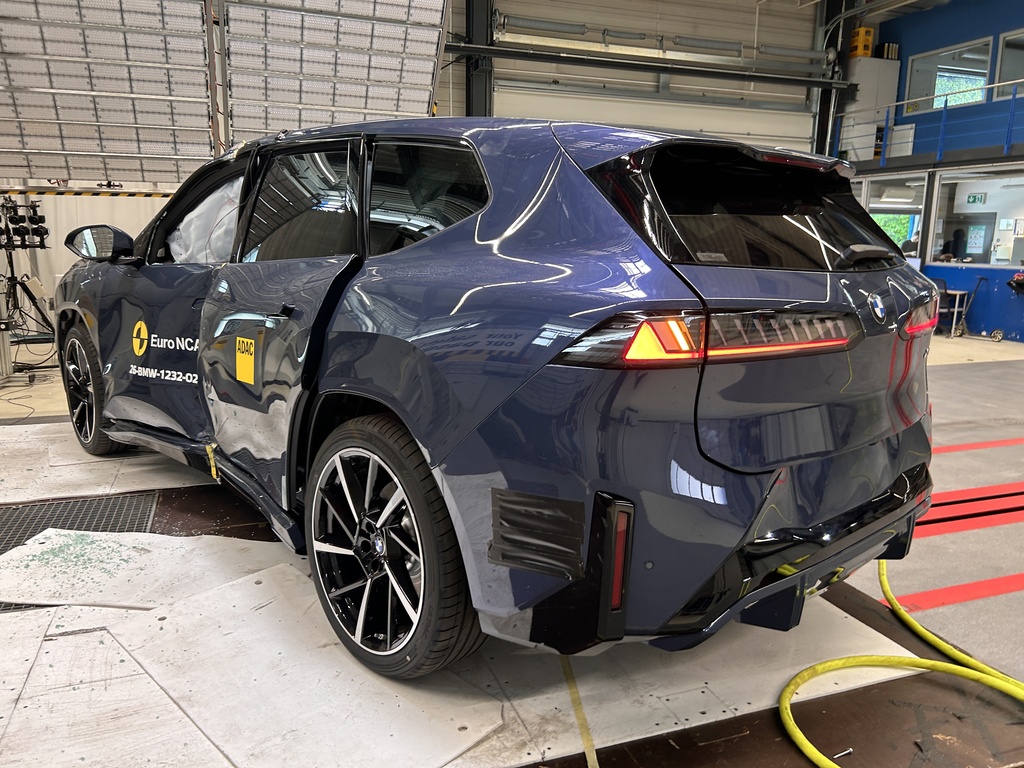
The BMW iX3 has become the first vehicle to achieve a five-star ANCAP safety rating under the organisation’s 2026–2028 assessment criteria. It demonstrated strong performance across crash avoidance, occupant protection, driver assistance and post-crash safety.
Tested against ANCAP’s latest protocols, the all-electric SUV recorded high scores across all four assessment pillars and became the first model to be evaluated under the organisation’s new “Stages of Safety” approach.
Strong all-round safety performance
The BMW iX3 delivered a comprehensive combination of safety technologies, crash protection and post-crash capabilities, making it the first vehicle to achieve a five-star rating under the new 2026–2028 assessment criteria.
Among its Safe Driving features, the iX3 offers dedicated physical controls for key driving functions, including the indicators, hazard lights, headlights and gear selector. During ANCAP’s new on-road assessment of speed limit recognition, the vehicle correctly identified 73 per cent of speed change events, equivalent to 92 per cent of the distance driven.
The BMW iX3 also demonstrated strong performance across ANCAP’s crash avoidance and occupant protection assessments, including:
- Driver monitoring sensors that detect fatigue, impairment and distraction, with particularly strong performance in fatigue and impairment detection.
- An autonomous emergency braking system that exceeded Australian, New Zealand and European regulatory requirements, performing well in same-direction and turning scenarios involving vehicles and motorcycles.
- Strong pedestrian and cyclist detection, along with effective lane departure avoidance.
- Maximum scores in all side impact crash tests and the new three-occupant full-width frontal crash test introduced under the 2026 protocols.
- Good protection for occupants of different body sizes and across varying crash configurations during additional robustness testing.
For Post-Crash safety, it achieved a score of 95 per cent. ANCAP said the vehicle is equipped with an eCall system that automatically transmits crash location and severity information to emergency services, with the feature provided to Australian and New Zealand owners for the life of the vehicle. As an all-electric model, it also demonstrated effective battery voltage isolation and post-crash fire risk management. The electrically operated door handles remained functional following crash testing, and a manual door release was also confirmed.
New framework assesses four stages of vehicle safety
The BMW iX3 is the first model to be assessed under ANCAP’s new 2026–2028 safety criteria, which expand the organisation’s focus beyond traditional crash testing to recognise the complete sequence of vehicle safety—from helping drivers avoid collisions to supporting occupants after a crash.
The revised framework assesses vehicles across four key stages:
- Safe Driving – How the vehicle supports the driver and promotes safer driving.
- Crash Avoidance – How effectively the vehicle detects hazards and helps prevent or mitigate collisions.
- Crash Protection – The level of protection provided by the vehicle’s structure, airbags and restraint systems.
- Post Crash – Features that assist emergency responders and improve occupant outcomes after a collision.
“Safe Driving helps reduce mistakes; Crash Avoidance helps prevent collisions; Crash Protection remains the foundation of occupant safety when a crash cannot be avoided; and Post Crash helps improve survival and recovery when every minute counts,” said Carla Hoorweg, Chief Executive Officer of ANCAP Safety.
“Over three decades of ANCAP influence, this is the most comprehensive ratings framework we’ve applied. We have again stepped up our assessment to capture and evaluate the many ways a modern car can protect its occupants and other road users.”
“The BMW iX3 is the first model we’ve put through this new rating process, and its specification and performance have captured the essence of the new requirements.”
New criteria reflect evolving vehicle technologies
ANCAP said the updated assessment retains all traditional crash tests while expanding its focus to better reflect modern vehicle designs and real-world crash scenarios.
“Importantly, this new approach retains all of the traditional crash tests ANCAP is synonymous with. Building on this, our 2026 requirements encourage even better protection for a broader range of occupants through restraint systems and vehicle designs that cater for people of different body types and sizes. Fuel leakage and EV battery integrity are also now reviewed as part of the crash-test assessments – particularly relevant given the increasing number of electric vehicles now on our roads,” said Hoorweg.
She added that emergency response technologies now form part of the assessment.
“Another new area of focus is eCall. eCall is an automatic crash function that notifies emergency services of a crash and its location. It can help first responders understand the nature of the crash before they arrive at the scene, helping them to prioritise treatment for those involved.”
ANCAP has also introduced greater emphasis on how driver assistance systems perform in everyday use.
“Taking on board consumer feedback, our 2026 rating system encourages manufacturers to develop systems that drivers are happy to leave switched on. Systems that irritate rather than improve the driving experience will be marked down, with lane keeping systems now assessed on how naturally they interact with the driver, including steering response and driver override effort,” Hoorweg said.
“The ‘smart coupling’ of driver alertness with safety system intervention is also now assessed. Vehicles that enhance – or minimise – their response according to the driver’s level of alertness are rewarded.”
Additional changes introduced from 2026
Alongside the new Stages of Safety framework, ANCAP has introduced several new testing requirements under its 2026–2028 protocols, including:
- a redesigned full-width frontal crash barrier that better reflects real-world collisions
- expanded crash avoidance assessments across different lighting and weather conditions, rollover protection testing
- “pothole” stability testing, enhanced whiplash assessments
- a motorcycle T-bone autonomous emergency braking test, and
- automatic 50 per cent score deductions where serious component failures occur during testing.
The full 2026–2028 ANCAP testing and rating criteria, along with the BMW iX3’s detailed assessment results, can be viewed here.
Did you find this article interesting? Click the ‘heart’ button above to give it a ‘like’!