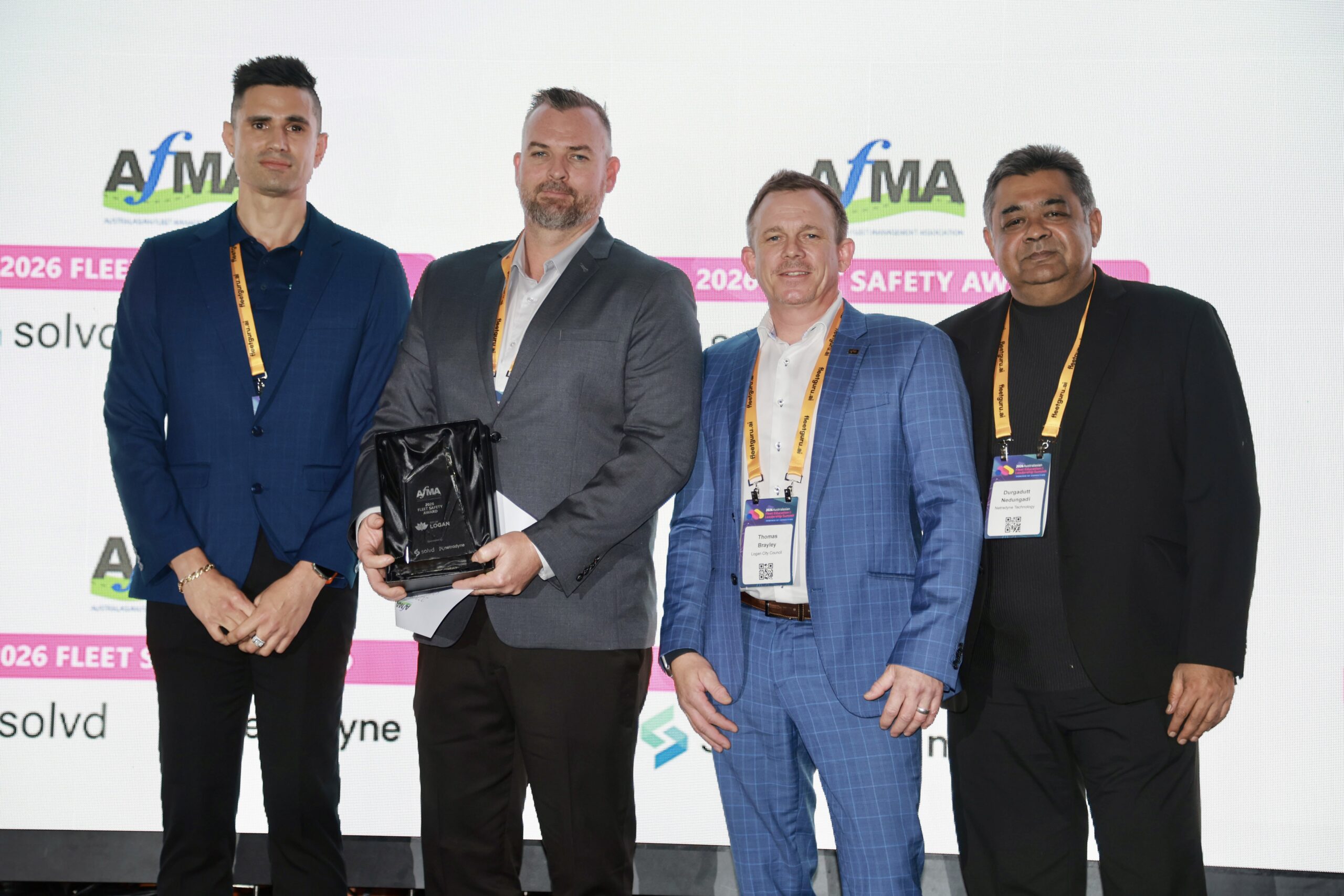
The Australasian Fleet Management Association is proud to announce City Fleet, Logan City Council as the winner of the 2026 Fleet Safety Award.
City Fleet at Logan City Council demonstrated an unwavering commitment to fleet safety through its structured Five‑Year Safety Journey, commenced in 2020. While the initial five‑year program concluded in 2025, safety continues to be embedded as a mature, holistic system that has progressed well beyond its original timeframe.
Safety at the core
Safety was not treated as a single‑layer priority but embedded as a core organisational value, evident in Logan City Council’s leadership behaviours, governance frameworks and operational practices. Over time, the organisation transitioned from a predominantly compliance‑based approach to a more mature, system‑led model, supported by programs that required visible and active leadership involvement at every level.
At the forefront of this initiative is the thorough and cultural revamp of their perspective of safety, driven by the organisations Target Zero initiative A . Target Zero is a Logan City Council, CEO‑led safety program, formally launched as an organisation‑wide initiative to progress the Council’s long‑term commitment to eliminating work‑related injuries and illnesses. City Fleet adopted and operationalised this corporate direction within fleet operations as part of its broader safety journey.
That commitment translated into sustained performance outcomes, with City Fleet achieving 447 consecutive days without a Lost Time Injury (LTI).
Beyond the Zero Harm framework, City Fleet deliberately strengthened its safety architecture through the integration of in‑vehicle monitoring and dash camera systems, supported by proactive hazard reporting, structured inspections, and real‑time performance dashboards.
Across the board
City Fleet’s commitment to safety extended well beyond individual initiatives, driving a deliberate cultural shift that embedded safety expectations at every level of the organisation. Risk management and safety were repositioned from passive compliance activities to active, visible leadership behaviours.
Safety became a clear executive priority, with the organisation’s Collective Leadership Team (CLT) actively participating in hazard hunts and frontline safety activities. In one hazard hunt alone, approximately 30 hazards were formally identified, with 71 per cent closed within short timeframes, reinforcing timely action and ownership.
This leadership focus was further strengthened through regular participation in safety workshops and training, with fleet safety embedded as a standing item in executive reporting and routinely reinforced through scheduled leadership forums and meetings.
To sustain momentum and accountability, City Fleet established a dedicated Fleet Compliance Officer role to support continuous improvement and ensure ongoing alignment with safety standards and regulatory requirements.
Senior leaders also adopted a monthly “walk‑the‑floor” approach, creating consistent and open dialogue between leadership and operational teams and reinforcing safety as a shared, everyday responsibility.
To reduce reliance on one‑off training and drive sustained performance, City Fleet introduced self‑paced audits. These audits enabled teams to identify gaps, implement corrective actions in real time, and strengthen accountability through continuous verification rather than periodic review.
Reporting as regular behaviour
The principle of “no blame, only improvement” became central to City Fleet’s safety culture, reframing safety reporting as a proactive tool for learning rather than a compliance exercise. This marked a deliberate shift away from safety being viewed as paperwork, towards an open and constructive approach focused on continuous improvement.
Toolbox Talks (TBTs) played a key role in this shift, providing a structured forum for teams to discuss real incidents, near‑misses and hazards. These conversations helped build shared understanding, transfer practical lessons, and normalise reporting as part of everyday operations.
To reinforce the desired behaviours, safety reporting was actively recognised and rewarded through visible acknowledgment on public boards, formal Safety Awards and the Health and Safety Representative (HSR) Incentive Program. A structured reward and recognition framework was also introduced to celebrate safety leadership and positive contribution.
City Fleet supported this cultural change with systems that made reporting easy and accessible. Intelex was implemented as the primary platform for incident, hazard and near‑miss reporting, centralising data and enabling more effective tracking, analysis and trend identification.
For serious incidents, City Fleet adopted Taproot investigation methodology, supported by targeted training and, where appropriate, external specialist expertise. This ensured investigations focused on understanding root causes and strengthening controls, rather than attributing blame.
Over time, City Fleet observed a measurable increase in reporting activity, reinforcing that when reporting is encouraged, recognised and acted upon, it becomes a natural and valued part of safe work.
Keeping safety visible
To reinforce safety as a constant and visible priority, City Fleet introduced an electronic noticeboard within the lunchroom, providing real‑time safety messaging, alerts, and performance updates that kept safety front of mind during everyday interactions.
This was complemented by a permanent Lost Time Injury (LTI) board, allowing teams to visibly track LTI‑free days and reinforcing collective accountability for safety performance.
Capability was further strengthened through annual driver safety training, combining targeted videos with practical workshops. These sessions focused on defensive driving, fatigue management and vehicle‑specific risks relevant to fleet operations. Staff were also encouraged to actively engage in safety pledges and awareness activities during National Road Safety Week, reinforcing shared responsibility beyond formal training environments.
External validation
City Fleet’s approach to safety was supported by external validation through Quality Management accreditation, reinforcing the robustness, consistency and longevity of its governance framework.
This was underpinned by a comprehensive suite of Workplace Health and Safety policies, procedures and supporting controls, including:
- Health, safety and wellbeing policy
- Target Zero strategy
- Pre‑start inspection requirements
- Regular maintenance schedules
- Vehicle and plant risk assessments
- E‑learning driver behaviour training
- Code of Conduct
- People Plan
- Incident escalation and reporting protocols
- Vehicle allocation and use terms and conditions management directive
- Chain of Responsibility (CoR) Policy (under review)
- Work‑Related Vehicle Safety – Driver Behaviour Procedure (in draft)
Together, these instruments provided the structure, clarity and governance necessary to sustain a mature, system‑led approach to fleet safety.
Safety as investment
City Fleet invested in fit‑for‑purpose monitoring and assurance systems to improve safety visibility, strengthen frontline decision‑making and support early intervention.
Vehicle monitoring and telematics were progressively installed across all fleet vehicles and major plant, incorporating in‑vehicle monitoring systems (IVMS) and dash cameras. These systems enabled continuous monitoring of critical driver behaviours such as speed, braking and seatbelt use, supported geofenced alerts, captured incident footage, and allowed fleet supervisors and drivers to review IVMS data as part of daily operations.
Safety capability was further enhanced through the introduction of smart safety technologies. COBO electrical security software was deployed to alert operators to vehicle faults and require acknowledgement before equipment operation, strengthening pre‑use controls. Tilt sensors were installed on heavy vehicles to mitigate rollover risk, and plant assessor software was introduced to provide a consistent, system‑wide approach to identifying and assessing plant‑related risks.
To support oversight and accountability, City Fleet developed internal safety dashboards that enabled managers to monitor key safety indicators in real time. These dashboards improved visibility of trends, supported informed decision‑making and ensured safety performance remained an active element of day‑to‑day operational management.
Key achievements
- 447 consecutive Lost Time Injury (LTI)‑free days, reflecting sustained safety performance rather than short‑term improvement.
- Zero LTIs recorded in 2025 and year‑to‑date, following six LTIs in 2024, demonstrating a clear downward trend and risk reduction.
- Quality Management accreditation, providing independent validation of governance, consistency and system maturity.
- 97.5% reduction in insurance claims, from 163 claims in 2020 to just 4 as at February 2026.
- Reduction in driver‑at‑fault incidents, supported by in‑vehicle monitoring, dash cameras and proactive intervention.
- Executive‑led hazard hunts, identifying up to 30 hazards in a single activity, with 71% closed within short timeframes, reinforcing leadership accountability and timely risk treatment.
- Three‑fold increase in recorded safety observations, indicating improved reporting culture, workforce confidence and engagement.
- Centralised incident and hazard reporting through Intelex, improving trend analysis, learning and assurance.
- Adoption of Taproot investigation methodology for serious incidents, strengthening root cause analysis and preventative controls.
- Embedding safety as “business as usual”, with visible leadership engagement, walk‑the‑floor programs, structured audits and active frontline participation across all levels of the organisation.