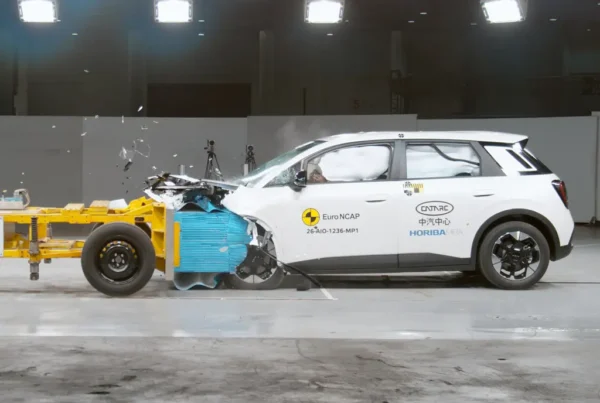
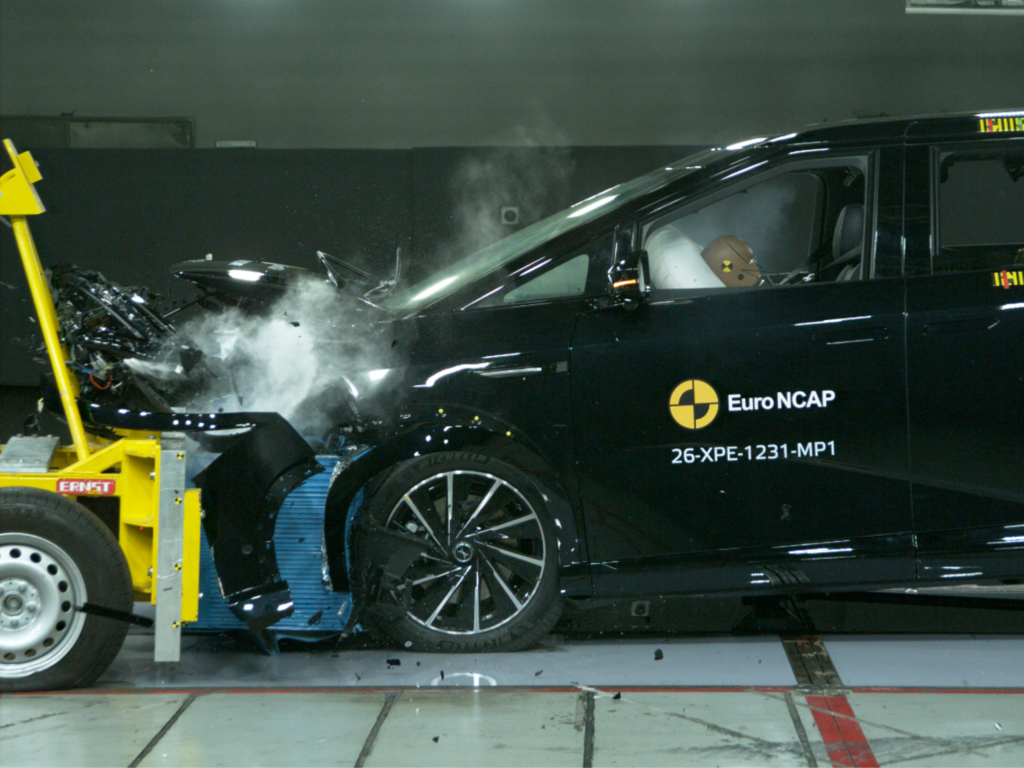
The XPENG X9 electric people mover has received a five-star safety rating from the Australasian New Car Assessment Program (ANCAP), achieving strong results in crash protection, collision avoidance and post-crash safety under ANCAP’s 2026–2028 assessment criteria.
In Australia and New Zealand, the rating applies to all variants built from January 2026 onwards. The X9 went on sale in New Zealand in June 2026 and in Australia in August 2026, with the rating valid until December 2034.
The X9 recorded a 91 per cent score for Crash Protection, 91 per cent for Post Crash, 82 per cent for Crash Avoidance and 56 per cent for Safe Driving.
Strong crash protection for occupants of sizes
The X9 achieved high scores across frontal, side and rear-impact assessments, including maximum scores for driver, passenger and child occupants in the frontal offset and full-width frontal tests.
Additional virtual simulations and sled testing demonstrated good or adequate protection for occupants of different sizes across a range of crash severities, reflecting the expanded testing introduced under ANCAP’s latest criteria.
Maximum scores were also recorded for adult and child occupants in the side-impact test. A centre airbag between the front seats helped limit occupant movement and reduce the risk of the driver and front passenger striking one another during a side collision.
However, ANCAP applied a deduction for the X9’s crash compatibility in head-on collisions, where its structure presents a moderate risk to occupants of an oncoming vehicle.
Protection for pedestrians and cyclists was mixed. Head protection was generally better around the windscreen, while weaker areas were identified across the bonnet. Pelvis protection was marginal, although protection for the femur, knee and lower leg was good.
Collision avoidance systems score highly
The X9’s autonomous emergency braking (AEB) system performed well in longitudinal and turning scenarios involving other vehicles and motorcycles. It also performed well across assessed pedestrian and cyclist scenarios.
Low-speed collision avoidance was another strength, with maximum scores recorded when turning across the path of another vehicle or motorcycle. The system also achieved maximum scores for avoiding pedestrians when reversing.
However, the X9 did not demonstrate performance in forward pedal-misapplication scenarios, which assess whether a vehicle can prevent unintended acceleration towards an obstacle.
The lane departure system performed well in preventing the X9 from moving into the path of an oncoming or overtaking car or motorcycle, but was less effective at preventing the vehicle from running off the road.
ANCAP also noted that the sensitivity of the AEB and lane departure systems did not adjust according to the driver’s level of awareness, increasing the potential for unnecessary intervention.
Driver monitoring and touchscreen controls need improvement
Safe Driving was the X9’s lowest-scoring assessment category, at 56 per cent.
The vehicle includes seatbelt reminders for all seats and can detect incorrect seatbelt use. However, it cannot classify occupants according to their size or detect a front passenger sitting in an unsafe position, such as with their feet on the dashboard.
A child presence detection system can alert the driver if a child has been left in the vehicle. The driver monitoring system demonstrated some ability to detect fatigue and distraction but did not detect mobile phone use.
ANCAP also identified limitations in the vehicle’s driving controls because some key functions required use of the central touchscreen instead of readily accessible physical controls.
“Our 2026 safety rating requirements are comprehensive and ambitious, encouraging manufacturers to deliver a broader range of safety features and higher levels of protection,” said ANCAP chief executive Carla Hoorweg.
“We want to see carmakers bring back buttons for the functions drivers use every day. Adjusting your windscreen wipers, switching on your headlights or clearing a fogged-up windscreen should be simple, intuitive and achievable without taking your attention off the road.”
The X9’s adaptive cruise control performed well in detecting and responding to other vehicles, motorcycles, pedestrians and cyclists. It also achieved maximum scores for adapting to road features such as roundabouts and crossings, and for resuming cruise control after the vehicle came to a complete stop.
Child restraint compatibility varies
The X9 is equipped with lower ISOFIX anchorages and top tether anchorages for outboard seats in the second and third rows.
Almost all selected child restraints could be installed correctly during testing. However, one convertible child restraint could not be fitted correctly in its forward-facing configuration in the outboard seats of the second row.
Child restraints should not be installed in the centre seating position of the third row because a top tether anchorage is not provided there.
Battery and post-crash safety
The X9 achieved a 91 per cent score for Post Crash, with rescue information for emergency responders meeting ANCAP requirements.
As a battery electric vehicle, the X9 demonstrated effective high-voltage battery isolation and post-crash fire risk management.
The model is equipped with the hardware required for emergency calling (eCall), although function is not yet active. XPENG has committed to making eCall operational in all X9 vehicles by October 2027, a commitment ANCAP required before awarding points in this assessment.
Maximum points were awarded for seatbelt buckle release, exterior door opening and tailgate opening following a crash. However, no points were awarded for interior door opening because the emergency release for the rear door was not easily accessible.
Did you find this article interesting? Click the ‘heart’ button above to give it a like!