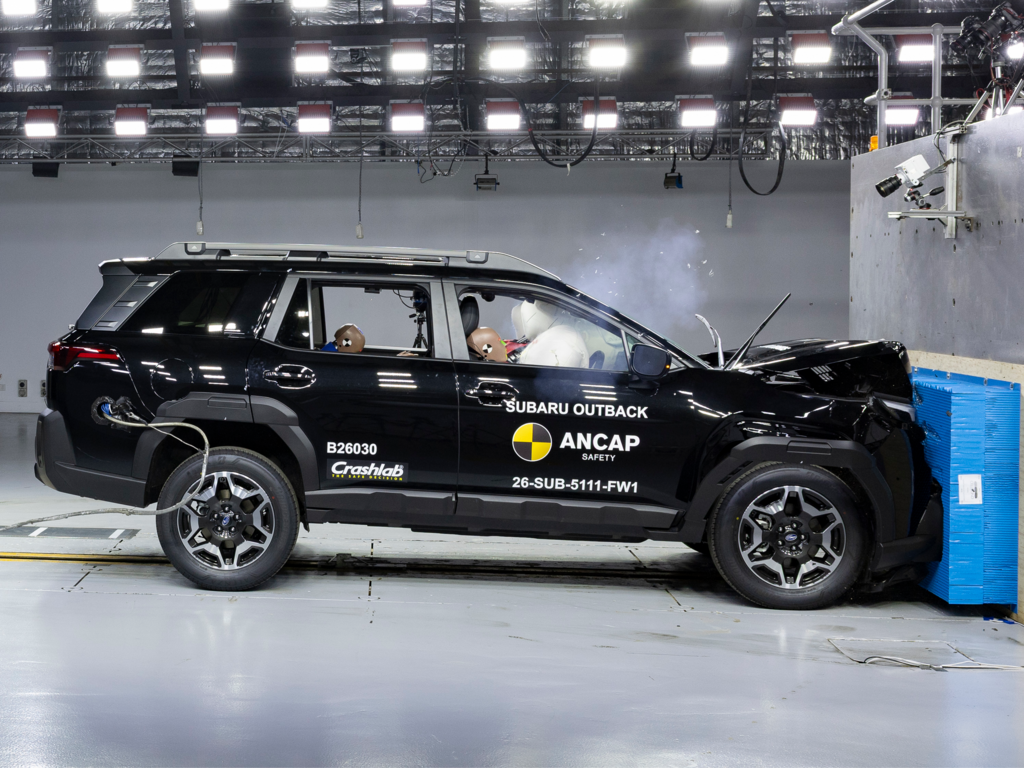
The large plug-in hybrid SUV BYD Sealion 8 has received a five-star safety rating from the Australasian New Car Assessment Program (ANCAP), with strong results in crash protection and post-crash safety.
The rating applies to all variants of the Sealion 8 introduced in Australia and New Zealand from February 2026. The vehicle was assessed against ANCAP’s 2026–2028 criteria, with the rating valid until December 2034.
The Sealion 8 achieved the following scores across ANCAP’s four assessment categories:
| Assessment category | Score |
| Safe Driving | 73% |
| Crash Avoidance | 76% |
| Crash Protection | 90% |
| Post Crash | 100% |
ANCAP CEO Carla Hoorweg said the latest results reflect manufacturers’ continued investment in vehicle safety, while highlighting differences in performance, design and specification that independent testing can identify.
“These latest results reflect the considerable effort manufacturers continue to invest in vehicle safety, while highlighting important differences in performance, design and specification that only our independent testing brings to light.”
Driver monitoring and assistance systems
The Sealion 8’s driver monitoring system performed well in detecting short-duration distraction, such as when a driver takes their eyes off the road. However, its performance was more limited in identifying unresponsiveness and impairment.
The system can detect an unresponsive driver and issue escalating visual and audible warnings. If the driver does not respond, it can use steering and braking assistance to slow the vehicle, activate the hazard lights, and bring it to a controlled stop.
The assessment also found that the system did not demonstrate effective occupant classification or detection of occupants sitting out of position. Seatbelt monitoring performed well, including detection of incorrectly worn seatbelts and rear-seat occupancy. A child presence detection system is also fitted.
ANCAP found that the vehicle’s driving, comfort and infotainment controls met its requirements for ease of access and operation, helping reduce unnecessary driver distraction.
The adaptive cruise control system performed well when responding to other vehicles and vulnerable road users, but could not respond to road features such as roundabouts and crossings. The speed-limit information system also showed limitations.
Crash avoidance performance
The Sealion 8’s autonomous emergency braking (AEB) system performed well in many assessed scenarios, particularly when approaching vehicles travelling ahead and in turning scenarios involving vehicles, motorcyclists and pedestrians.
Performance was less consistent in complex intersection situations, including when vehicles or motorcycles crossed its path, or when the SUV turned across the path of a cyclist.
The vehicle performed strongly in lane-support assessments, with effective intervention when it unintentionally drifted towards the road edge or into the path of oncoming or overtaking vehicles and motorcycles.
At lower speeds, results were good in car-to-car and car-to-motorcycle scenarios. However, pedestrian detection while manoeuvring was limited. No intervention was recorded when travelling forwards, while effectiveness was reduced when reversing.
Crash protection
The Sealion 8 provided an overall good level of occupant protection across ANCAP’s crash tests. Strong results were recorded in side-impact testing, including collisions with another vehicle and a narrow roadside object such as a pole. A centre airbag is fitted to help reduce the risk of injury caused by contact between front-seat occupants.
Maximum points were achieved for whiplash protection in rear-end collisions. Protection for pedestrians and cyclists was varied, with good results for the femur, knee and lower leg, but increased injury risk identified in some areas of the pelvis and head, particularly for cyclists.
A separation in the driver-side footwell was observed behind the brake and accelerator pedals following the frontal offset crash test. While this did not increase the measured injury risk to key body regions of the driver dummy, ANCAP said a loss of footwell integrity could increase the risk of lower-limb injuries. A penalty was applied to the crash protection score, and the finding was shared with BYD.
Child restraint anchorages are provided across the second and third seating rows, although installation options are limited in the third row. Families should check the compatibility of their chosen child restraint with the intended seating position before installation.
Post-crash safety
The Sealion 8 achieved 100 per cent in ANCAP’s Post Crash assessment. The SUV is equipped with multi-collision braking, which can help prevent or reduce the severity of subsequent impacts following an initial collision. Automatic hazard light activation alerts other road users after a crash.
Rescue sheets and an emergency rescue guide are available to help first responders identify important vehicle components and manage rescue operations. These resources are particularly important for plug-in hybrid vehicles, which contain high-voltage electrical components.
The assessment also recorded good results for occupant extrication, including seatbelt release, door and tailgate operation, and vehicle submergence. The Sealion 8 was assessed for high-voltage energy isolation and thermal propagation to help reduce electrical and thermal hazards following a collision.
Hoorweg said consumers looking for a new vehicle should use ANCAP’s ratings to help make an informed safety choice.
“For consumers in the market for a new car, the easiest way to make a safe choice is to visit the ANCAP website where our easy-to-understand star ratings provide simple guidance at a glance.”
View the full BYD Sealion 8 ANCAP safety assessment.
Did you find this article interesting? Click the ‘heart’ button above to give it a like!