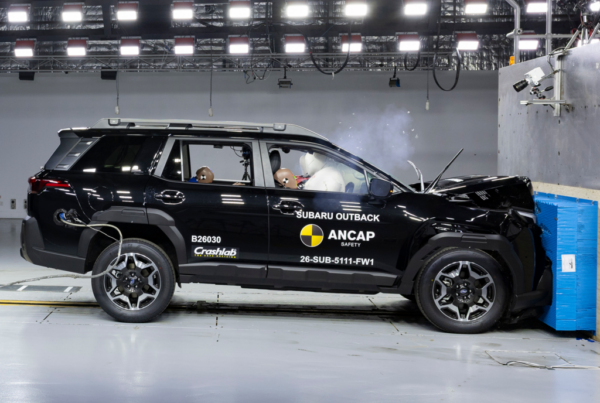
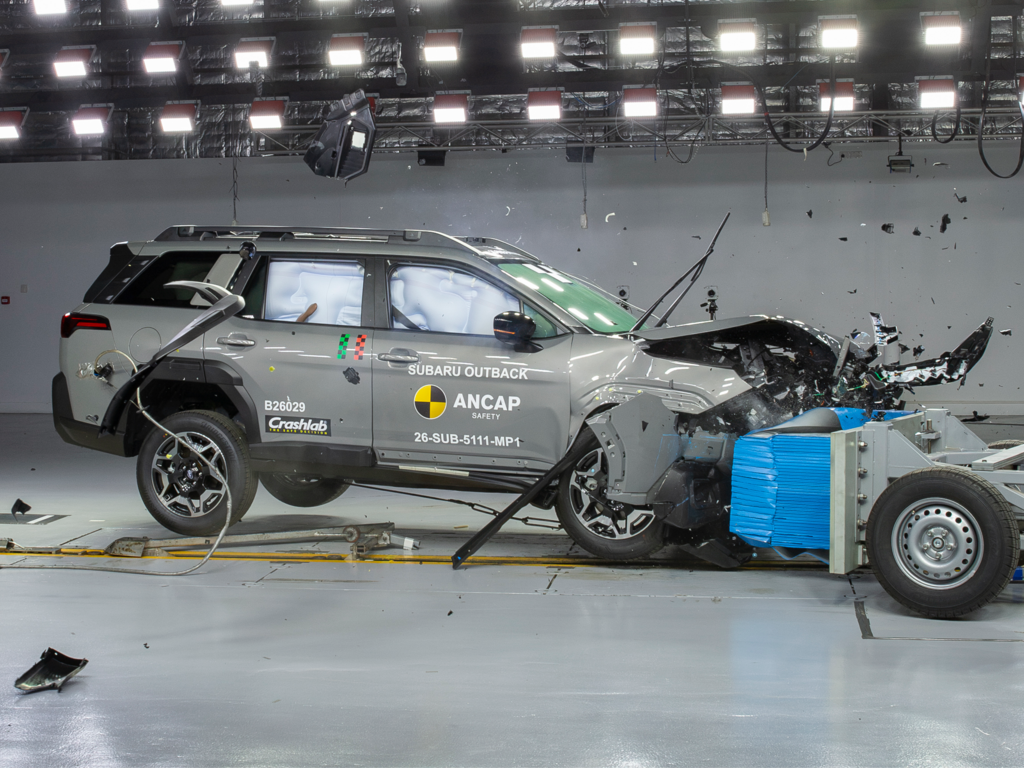
The petrol-powered Subaru Outback has received a five-star safety rating from the Australasian New Car Assessment Program (ANCAP), with strong results in crash protection and pedestrian impact testing.
The large SUV was assessed under ANCAP’s 2026–2028 criteria. Its five-star rating applies to all variants and expires in December 2034.
The Outback achieved the following scores across ANCAP’s four assessment categories:
| Assessment category | Score |
| Safe Driving | 64% |
| Crash Avoidance | 66% |
| Crash Protection | 92% |
| Post Crash | 80% |
“So far this year, we have seen manufacturers deliver an almost clean sweep of five-star performers, with all but one model assessed against our new 2026 Stages of Safety rating criteria meeting the elevated safety standard,” said ANCAP CEO Carla Hoorweg.
Safe driving and assistance systems
The Outback can detect when rear seats are occupied and remind occupants to wear their seatbelts. It can also recognise the size of the front passenger and adjust airbag deployment accordingly.
The vehicle does not have a system to detect if a child has been left unattended or warn when an occupant is sitting in a position that could increase their risk of injury in a crash.
Its driver monitoring system can detect signs of distraction, fatigue and impairment. The layout and operation of essential driving, comfort and infotainment controls met ANCAP’s requirements for ease of access and operation, achieving full points.
The speed assistance system can recognise posted speed limits and help drivers maintain an appropriate speed, although its ability to accurately identify speed limits was mixed.
Adaptive cruise control adjusts speed in response to surrounding traffic but showed limitations when responding to motorcycles, pedestrians and cyclists. Steering assistance can help the driver remain in their lane, while assisted lane changing is available only on the Touring variant.
Crash avoidance
The Outback’s autonomous emergency braking (AEB) system demonstrated good performance in several assessed scenarios, particularly when turning across the path of another vehicle or pedestrian, and when approaching a cyclist travelling in the same direction.
Performance was less consistent at intersections, particularly when crossing the path of another car or motorcycle, or turning across the path of a cyclist.
The Outback performed well in tests of its lane support systems. These can intervene if the vehicle unintentionally drifts towards the road edge or into the path of an oncoming or overtaking vehicle. Strong results were recorded in scenarios involving cars and motorcycles.
At lower speeds, the Outback demonstrated an ability to avoid collisions in the assessed scenarios, including with other cars when turning or crossing at intersections and with pedestrians when moving forward. Its ability to detect and respond to pedestrians when reversing was limited.
The vehicle also showed limitations in low-speed scenarios involving motorcycles. It does not offer a system to warn occupants of an approaching cyclist before opening a door.
Crash protection
The Outback demonstrated strong crash protection, providing good levels of protection for adult and child occupants across a range of frontal and side-impact tests.
In the frontal offset crash test, good protection was provided to the driver, front passenger and child occupants seated in the rear. However, a penalty was applied because the assessment identified greater potential for the Outback to injure occupants of another vehicle in a collision.
Strong results were recorded in the full-width frontal test, with additional testing demonstrating good protection for occupants of different sizes across a range of crash speeds and severities.
Occupant protection in the side-impact and oblique side-pole tests was good. However, a penalty was applied because the side curtain airbags have not been shown to deploy in response to a rollover alone, unless a side impact has first triggered their deployment.
The head restraints provided good protection against whiplash injury in rear-end collisions, achieving full points.
The Outback’s front-end design provided good protection to pedestrians’ legs and pelvis. Protection to the heads of adult and child pedestrians was also generally good, although protection for cyclists was less favourable.
A range of child restraints can be accommodated in the second row, with ISOFIX anchorages for the two outer seating positions and top tether anchorages for all three rear seating positions. However, some child restraints could not be safely installed in certain seating positions.
Post-crash safety
The Outback provides features designed to assist occupants and emergency responders following a crash.
A rescue sheet and emergency rescue guide are available to emergency services to assist with the safe access and recovery of occupants.
The vehicle is equipped with a system that automatically applies the brakes following an initial collision to help prevent further impacts, and activates the hazard lights to warn other road users.
The Outback does not offer an automatic emergency call (eCall) system to notify emergency services following a serious crash. It met requirements for electrical energy isolation and occupant extrication, including the ability to release seatbelts and open doors following a collision.
ANCAP also demonstrated that if the Outback entered water, its windows would remain functional for the minimum required period to assist occupant escape.
View the full Subaru Outback ANCAP Safety Report and assessment.
Did you find this article interesting? Click the ‘heart’ button above to give it a like!