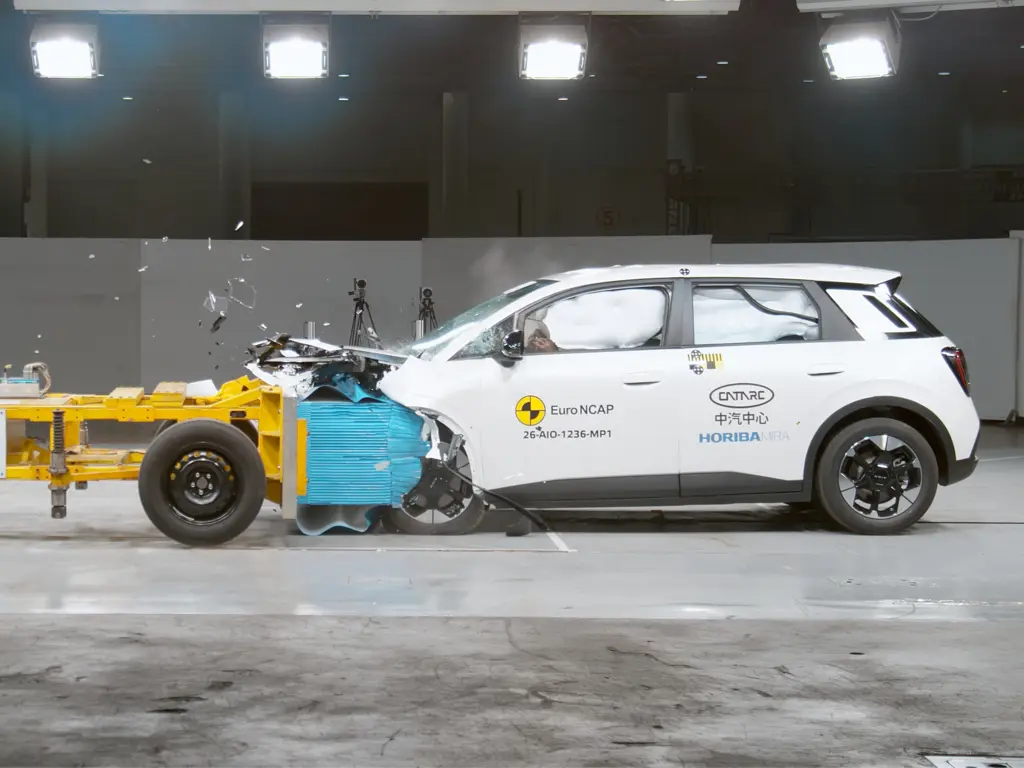
The GAC AION UT electric hatchback has received a five-star safety rating from the Australasian New Car Assessment Program (ANCAP), achieving strong results in crash protection and collision avoidance under the organisation’s 2026–2028 assessment criteria.
In Australia and New Zealand, the rating applies to all variants built from January 2026 onwards. The model went on sale in Australia in April 2026 and in New Zealand in May 2026, with the rating valid until December 2034.
The AION UT recorded a 90 per cent score for Crash Protection, 88 per cent for Post Crash, 74 per cent for Crash Avoidance and 68 per cent for Safe Driving.
Strong crash protection results
The AION UT performed well in frontal, side-impact and run-off-road crash assessments, including testing designed to evaluate protection for occupants of different sizes and across a wider range of crash severities.
The AION UT performed particularly well in side-impact assessments, achieving maximum scores. The centre airbag between the front seats also contributed to maximum scores in far-side impact testing by helping reduce the risk of occupants striking one another during a collision.
Additional virtual simulations and sled testing demonstrated high levels of protection for occupants of different sizes.
However, protection in the full-width frontal test was mixed, with marginal chest protection recorded for a small female driver. ANCAP also applied a deduction for crash compatibility in head-on collisions, where the vehicle’s structure presents an additional risk to occupants of an oncoming vehicle.
Protection for pedestrians and cyclists varied, with strong results for pelvis and leg protection but weaker head protection in some areas across the front of the vehicle.
Collision avoidance systems perform well
The AION UT’s autonomous emergency braking (AEB) system performed well in several advanced scenarios involving other vehicles, motorcycles, pedestrians and cyclists.
Performance was particularly strong when turning across the path of another vehicle or motorcycle and when approaching pedestrians and cyclists from behind.
However, the system was less effective when another vehicle crossed the AION UT’s path at an intersection and when the AION UT turned across a cyclist’s path.
The lane departure prevention system performed well in helping prevent the vehicle from running off the road or moving into the path of an oncoming or overtaking vehicle.
Low-speed collision avoidance performance was also generally good, although the vehicle does not prevent unintended forward acceleration towards a pedestrian when the driver presses the accelerator instead of the brake. Its ability to avoid pedestrians when reversing was limited, as was the performance of its system for warning occupants before they open a door into the path of a cyclist.
Occupant monitoring and child safety features
The AION UT includes systems to detect correct seatbelt use, rear-seat occupancy and front-seat occupants sitting in potentially unsafe positions. However, it cannot classify occupants according to their size.
A child presence detection system can alert the driver if a child has been left inside the vehicle. The driver monitoring system performed well in detecting common forms of distraction, but was less effective at detecting impairment or an unresponsive driver.
The vehicle is also equipped with lower ISOFIX anchorages for the rear outboard seats and top tether anchorages for all rear seating positions. All selected child restraints were installed safely during testing.
Touchscreen controls remain an area for improvement
The AION UT’s Safe Driving score was affected by its reliance on touchscreen controls for several commonly used functions.
While physical controls are available for some driving functions, others require interaction with the central touchscreen.
ANCAP has encouraged manufacturers to retain physical buttons and controls for key functions to help reduce driver distraction.
“Our 2026 safety rating requirements are comprehensive and ambitious, encouraging manufacturers to deliver a broader range of safety features and higher levels of protection,” said ANCAP chief executive Carla Hoorweg.
“We want to see carmakers bring back buttons for the functions drivers use every day. Adjusting your windscreen wipers, switching on your headlights or clearing a fogged-up windscreen should be simple, intuitive and achievable without taking your attention off the road.”
During on-road testing, the AION UT correctly identified 67 per cent of speed limit change events, equivalent to 94 per cent of the distance driven. Its adaptive cruise control performed well when detecting and responding to other vehicles, motorcycles, pedestrians and cyclists, but did not adapt to road features such as roundabouts and intersections.
Battery safety and post-crash performance
The AION UT achieved an 88 per cent score for Post Crash, with rescue information for emergency responders meeting ANCAP requirements.
As a battery electric vehicle, it also demonstrated effective high-voltage battery isolation and post-crash fire risk management.
The model has the hardware required to support emergency calling (eCall), although the function is not yet active. GAC has committed to making eCall operational in all AION UT vehicles by October 2027, a commitment ANCAP required before awarding points in this assessment.
Seatbelt buckles and interior door releases remained operable following crash testing, although it received lower scores for the ease of opening the doors and tailgate from outside. The vehicle also met the requirements for helping occupants escape if it entered water.
Did you find this article informative? Click the ‘heart’ button above to give it a like!